MARSB’s Native Species Lists for the Mid-Atlantic
Try out the new Custom Taxa List Builder! Access a more information-rich and dynamic level of interface with MARSB’s taxa recommendations for the mid-Atlantic. Find suitable plants with an emphasis on realistic production potential. Select taxa based on distributions, habitat conditions, and plant characteristics.
RECENT UPDATES:
Species lists for Delaware, New Jersey, and West Virginia are now available!
State Priority lists now available for all states!
Mobile-friendly access to lists now available through our species list catalog!
For a more guided approach to plant selection, filter through Curated Ecoregional Taxa Lists.
Use the Custom Taxa List Builder to construct plant lists for a wider range of detailed needs
For a mobile-friendly view, browse MARSB’s recommendation lists via the taxa list catalog 🡺
Before you start, read on to learn the details about our species lists!
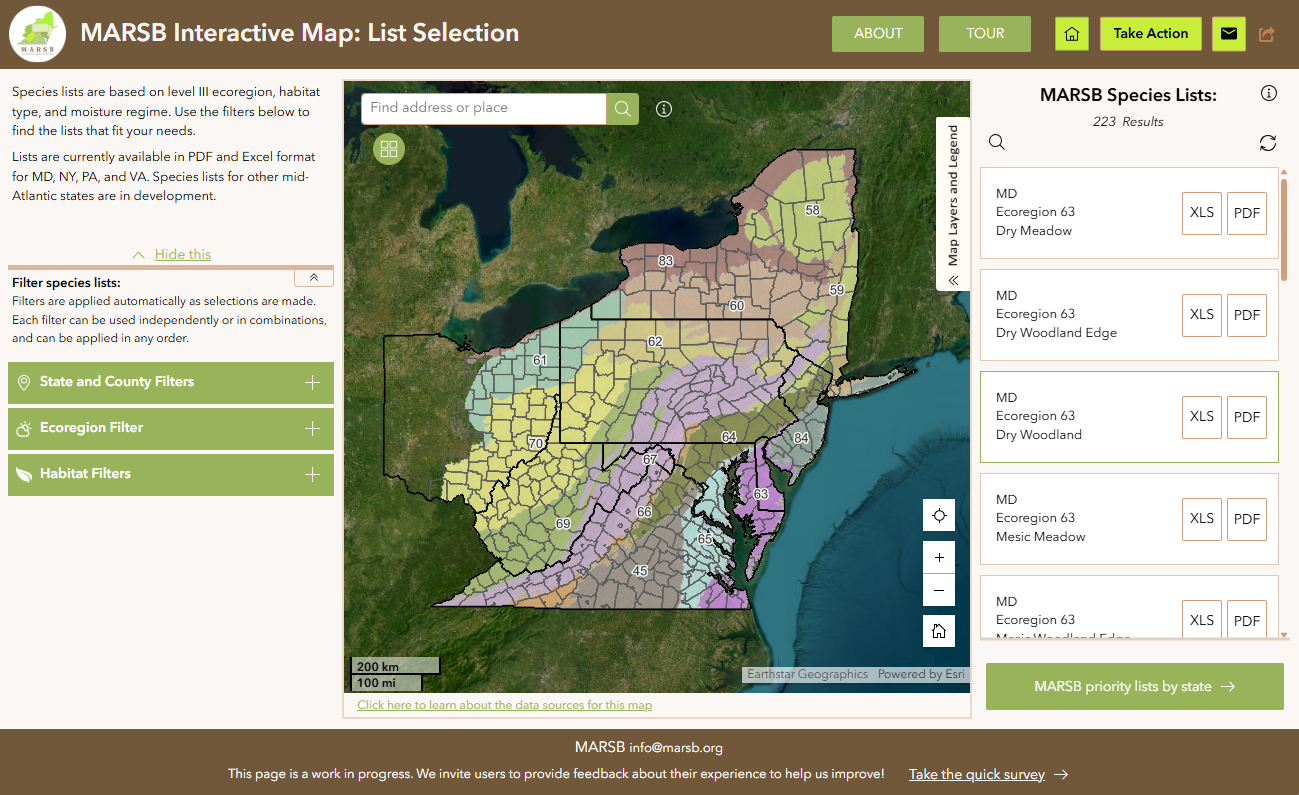
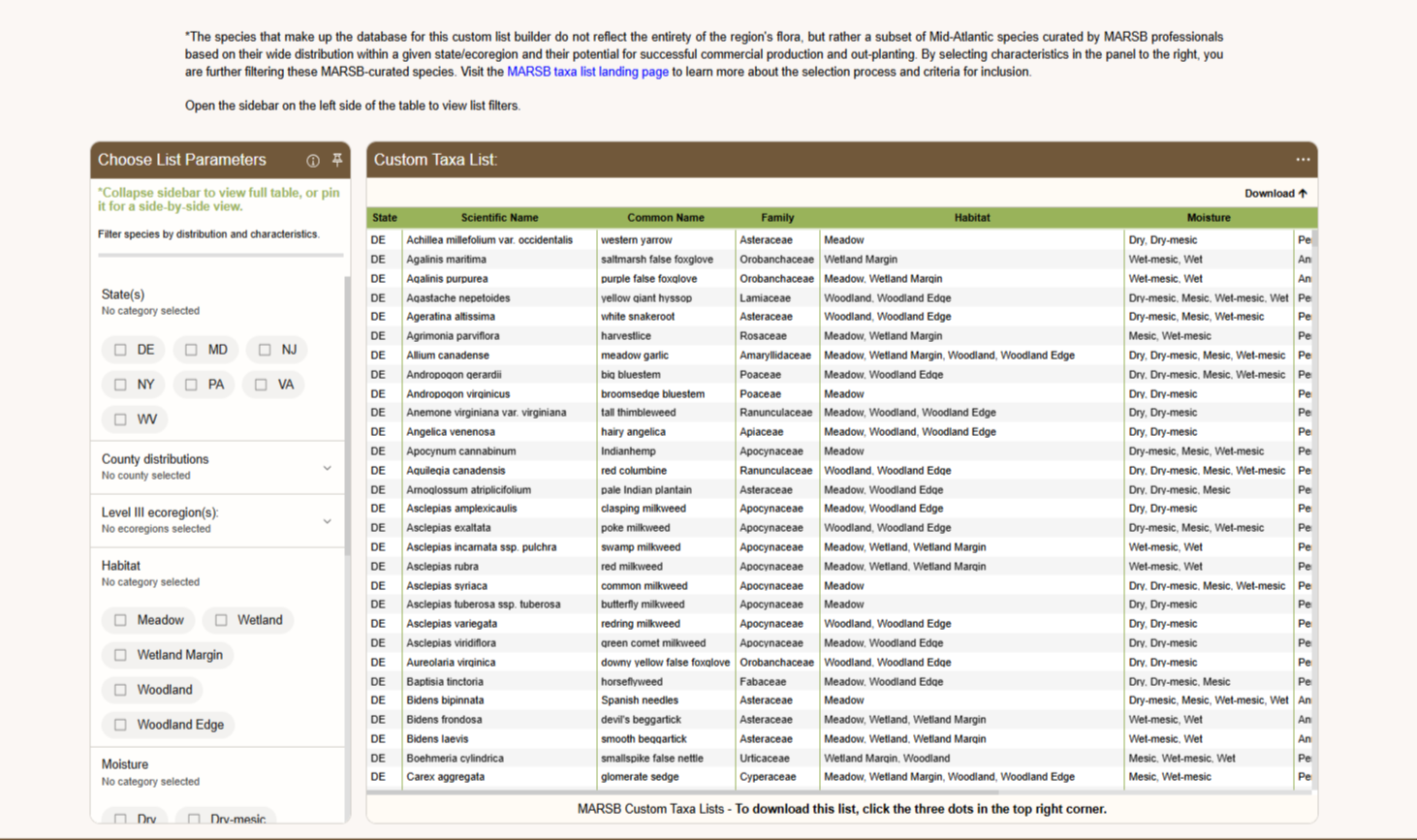
The Curated Ecoregional Taxa List web tool and Custom Taxa List Builder are designed for desktop use. Mobile viewing is not supported. If you have challenges accessing the features on our interactive tool, try another web browser or try clearing your cache.
“… for people to do their own ‘rewilding’ the MARSB tool is essential in getting the right habitat for that place established. It's these types of tools that are making ecological restoration more sustainable and precise.”
— Bram Gunther, Plan It Wild
-
Our lists are recommendations of native plants to be used for commercial production to meet the needs of restoration planting, land management, home gardening, and other horticultural applications. They are hand-selected to suit individual ecoregions across several ecological settings. The selections are based on natural plant distribution, proven use or potential for use in nursery production, and success in outplanting. While the lists are primarily focused on taxa that can be grown in seed increase plots, these plants also lend themselves to live plant production.
-
When considering how to help foster a thriving, self-sustaining native seed supply chain, we asked ourselves:
“Of the thousands of plants native to the Mid-Atlantic, which should be recommended to growers and end-users in order to focus demand and simplify the complex challenges facing the native plant material supply chain?” The key issues revolved around questions of producibility and demand.
Our answer was to create native plant target lists that are guided by distribution and habitat data, but focused on the practical realities of commercial seed production.
A note on conservation— The critical first step in our species selection process was to reference the best botanical data on the actual distribution of these species. This distribution reflects how these species interact with others to form ecological communities that are dynamic and complex. Central to the MARSB mission is to promote the long term health and sustainability of these populations and communities, most critically by guarding and strengthening the genetic variability resident in these populations and that is the result of their adaptation to local conditions through time. As we produce and use native plant materials it is essential that our practices support the continued health of natural systems. All conservation is local!
A note on horticultural uses— While our intent is primarily to meet the needs for ecological land management and restoration, contained within these lists are species that also exhibit all of the attributes sought by the horticultural community such as bloom time, color, seasonal appeal, etc. We invite the horticultural community to explore these uses with MARSB staff or to cross-reference our lists with other lists focused on these characteristics. You will find the plants that meet your needs and satisfy your aesthetics, while choosing species that conserve locally.
Furthermore, the horticultural and home gardening community are important consumers of native plants. Your use of these plants will help drive demand, which is critical to building and sustaining a vigorous native plant supply industry.
-
In order to filter the totality of the Mid-Atlantic plant taxa into a more practical, attainable subset for commercial production, MARSB considered the following factors. Selected taxa met all or most of these criteria:
Orthodox - produces seed which can be dried for multiple-year storage
Good Seed Producers - produces non-trivial seed quantities within the context of the habitat within which it occurs
Good Quality Seed Producers - produces seed with relatively high germination rates which is reasonable to harvest and clean
Adaptable to Cultivation - thrives in nursery cultivation, or if cultivation traits are unknown, is related to known taxa that do
Early Successional – early successional plants are frequently the most needed plant type for restoration plantings
Essential for Cultivation – taxa not so common in nature as to make commercial production redundant or unnecessary
Widespread - documented in a majority of counties in a given ecoregion
Beneficial - support pollinators and wildlife through nectar, pollen, foliage, and cover
Proven Successful - has documented success of establishment in restoration sites or is related to a plant which does
This selection process is ongoing as we add new habitat categories and work with regional experts to further refine chosen taxa. While we began with herbaceous plants because of their greater practicality for seed production, we are working on adding woody taxa as well.
-
Lists are categorized by: State, Ecoregion, and Habitat.
States: Lists for Delaware, Maryland, New Jersey, New York, Pennsylvania, Virginia, and West Virginia are currently available. Lists for eastern Ohio will be added shortly in 2026. (Eastern Ohio (largely the Appalachian Plateau) is floristically more closely related to the states to its east and south, than to the western portion of the state and the adjoining prairie biome.)
Ecoregions: Taxa lists are grouped by Level III ecoregions, derived from Omernik (1987). Ecoregions define areas of ecosystem similarity based on several factors, including climate, geology, hydrology, vegetation, land use, and more. They provide an important spatial framework for structuring the management of ecosystems and natural resources.
Habitats: Within an ecoregion, lists are grouped among several broadly-defined habitat types: meadow, wetland, woodland, and woodland-edge, and moisture gradients: dry, mesic, and wet.
Each list is further divided into Broad and Basic subsets.
The Broad subset is a rich mix of taxa with high biodiversity for that particular habitat type. It encompasses a variety of different families and phenologies, comprising an optimal mix for herbaceous restoration planting, were cost and availability not an obstacle.
The Basic subset includes what we consider the most essential taxa of the Broad subset. It provides ecological function in a basic structure to which complementary plants can later be added, or added where budgets allow for their generally limited, custom production. Basic subsets are composed of more than just statewide priority taxa (see below), acknowledging that ecoregional variations in taxa composition are widespread.
-
The State Priority Lists are MARSB’s first-tier recommendations for wide-scale commercial production and consist of taxa selected from among the ecoregional lists for their broad distribution within state boundaries. Our intention with the Priority Lists is to stimulate discussion and build consensus among growers and end users on the most critical taxa for large scale, sustained production, and thus enhance availability of these taxa. These lists do not include every taxon that could or should be put into commercial production, and in some instances include taxa that will require a more experienced, specialized grower for production.
Taxa included in a respective state’s priority list are documented in at least 75% of the state’s ecoregions and are not rare, threatened, or endangered.
-
We recognize that these taxa often require official oversight for their propagation. Many such taxa have formally adopted recovery plans to guide the process. We do not recommend growing or collecting these plants from the wild or producing these plants for general sales. We encourage collaboration with regional agencies to support the production and oversight of this process.
In the creation of the ecoregional lists, MARSB is attempting to present a complex mix of plants that is representative of particular geographies and habitat types, while also conforming to a set of refining guidelines. Is a particular plant native to the ecoregion in question? Was it once broadly (or more broadly) distributed throughout the region within its historical range? Does it lend itself to production? Does it lend itself to restoration? Will it be a quality addition to a seed mix or an outplanting?
Some state listed RTE (rare, threatened, endangered) taxa meet the requirements of these criteria and have been included in our lists. While some plants owe their rarity to a genetic propensity for low reproduction rates, others were once more common and have seen their ranges reduced by habitat loss and invasive species encroachment. Additionally, some are dependent on disturbance regimes that have been managed out of existence through fire suppression, herbicide use, or other means. Their inclusion in our lists is intended to not only acknowledge their role in current or potentially restorable environments, but also their capacity for production within the native plant supply chain.
-
The lists are housed in an interactive map tool that allows you to easily take geographic context and ecological factors into account when making plant selections.
If you already know what lists you’re looking for, skip to MARSB’s mobile-friendly catalog of ecoregional lists.
-
Yes! Please reach out to info@marsb.org if you would like to consult with an ecologist to build a custom plant list or review an existing one. A negotiated fee may be set depending on the scale of the request.
-
MARSB welcomes consultation and collaboration with local and regional experts on the content of the taxa lists. With an expanded network of on-the-ground experts, MARSB can continue to evolve these lists so that the taxa most integral to local ecosystems are reflected in the native plant material supply chain.
If you are interested in participating as a part of an expert committee, please contact info@marsb.org.
-
Agrecol Native Nursery. http://www.agrecol.com
Ernst Seed. http://www.ernstseed.com
Go Botany. Native Plant Trust. gobotany.nativeplanttrust.org
Harmon, P. J., D. Ford-Werntz, W. Grafton. 2006. Checklist and Atlas of the Vascular Flora of West Virginia. West Virginia Division of Natural Resources, Wildlife Resources Section, Elkins, WV. 381 p.
Kartesz, J.T. 2014, and continuously updated. The Biota of North America Program (BONAP). Taxonomic Data Center. (http://www.bonap.net/tdc). Chapel Hill, N.C. [maps generated from Kartesz, J.T. 2014. Floristic Synthesis of North America, Version 1.0. Biota of North America Program (BONAP). (in press)]
Maryland Plant Atlas Work Group. 2025. Digital Atlas of the Maryland Flora. MarylandPlantAtlas.org
McAvoy, W.A. 2026. The Flora of Delaware Online Database. Delaware Division of Fish and Wildlife, Species Conservation and Research Program, Smyrna, Delaware. https://delflora.org/flora/
McAvoy, W.A. 2024. Rare and Uncommon Plants of Delaware. Delaware Division of Fish and Wildlife, Delaware Department of Natural Resources and Environmental Control, Species Conservation and Research Program, Smyrna, Delaware. https://documents.dnrec.delaware.gov/fw/conservation/Rare-and-Uncommon-Plants-of-Delaware.pdf
Pennsylvania Natural Heritage Program. 2025. Environmental review list. https://www.naturalheritage.dcnr.pa.gov/Species.aspx
Prairie Moon Nursery. http://www.prairiemoon.com
Snyder, D. B. 2024. New Jersey Department of Environmental Protection State Parks, Forests & Historic Sites Forests & Natural Lands Office of Natural Lands Management New Jersey Natural Heritage Program, List of Endangered Plant Species and Plant Species of Concern. https://dep.nj.gov/wp-content/uploads/parksandforests/njplantlist.pdf
Society for Ecological Restoration, International Network for Seed Based Restoration and Royal Botanic Gardens Kew. 2023. Seed Information Database (SID). https://ser-sid.org/
Taylor Creek Restoration Nursery. http://www.taylorcreeknurseries.com
Townsend, J.F. 2026. Natural Heritage Resources of Virginia: Rare Plants. Virginia Department of Conservation and Recreation. https://www.dcr.virginia.gov/natural-heritage/document/plantlist-current.pdf
University of Maryland Extension. 2026. Commercial Maryland Native Plants List. https://extension.umd.edu/programs/environment-natural-resources/program-areas/maryland-native-plants-program/commercial-native-plant-list/
US Census Bureau, 2024, 2023 Cartographic Boundary File (SHP), County and Equivalent for United States, 1:500,000, accessed 2025 at URL https://www.census.gov/geographies/mapping-files/time-series/geo/cartographic-boundary.2024.html#list-tab-1883739534
U.S. Environmental Protection Agency, 2013, Level III Ecoregions of the Conterminous United States (published 20130416), accessed 2025 at URL https://www.epa.gov/eco-research/level-iii-and-iv-ecoregions-continental-united-states
Virginia Botanical Associates. 2025. Digital Atlas of the Virginia Flora. https://www.vaplantatlas.org
Werier, David, Kyle Webster, Troy Weldy, Andrew Nelson, Richard Mitchell, and Robert Ingalls. 2025. New York Flora Atlas. [S. M. Landry and K. N. Campbell (original application development), USF Water Institute. University of South Florida]. New York Flora Association, Albany, New York. https://newyork.plantatlas.usf.edu/
West Virginia Division of Natural Resources. 2020. Rare Plants tracked by the West Virginia Natural Heritage Program. https://wvdnr.gov/wp-content/uploads/2021/05/RTE_Plants.pdf